
39% of my pages were indexed, so I stopped adding more. That one figure, pulled from the page-indexing report for a Korea-travel affiliate site I run, told me something no traffic chart could: I was publishing faster than Google was willing to accept. Poor index coverage is a governor on the whole site, because a page that is not indexed earns nothing — no impressions, no clicks, no matter how good it is. Here is how I calculate the number, why crossing below a threshold means pausing instead of pushing harder, and how I triage the pages Google crawled but refused to keep.
The number that made me stop publishing
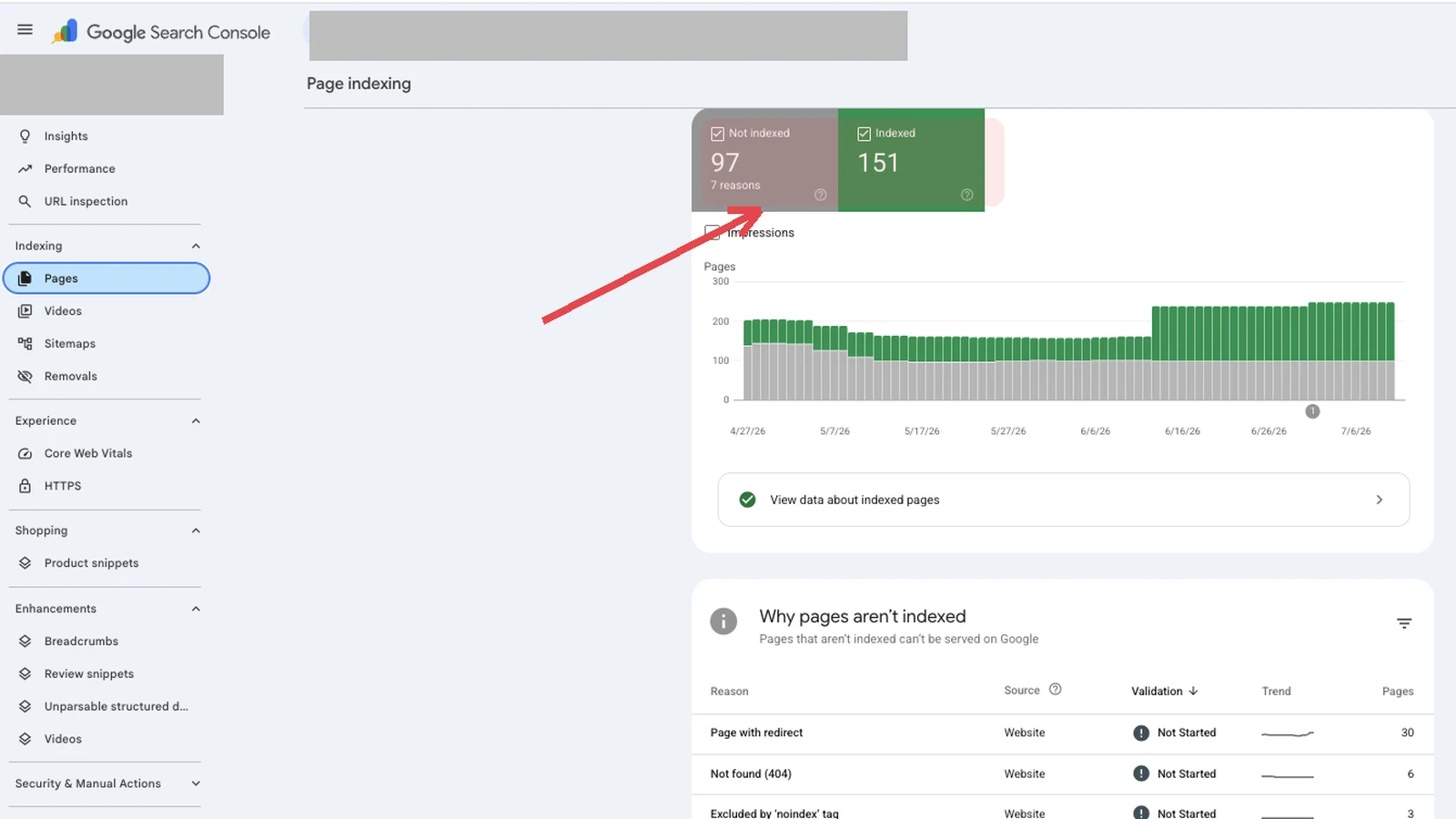
For months I measured progress by output: posts shipped, words written, the queue staying full. It felt like momentum. Then I actually read the page-indexing report and saw that well over half my URLs sat in the not-indexed column. All that output was landing in a bucket Google had decided not to show anyone. The chart I was proud of and the chart that mattered were telling opposite stories.
That is the moment the whole frame flipped. More posts was not progress; it was dilution. Every new URL that failed to get indexed did not just underperform on its own — it added to a pile that signals low overall quality, which makes the next page harder to index too. I was in a loop where publishing more actively slowed the indexing of everything, including the good pages. So I did the thing that felt wrong and stopped adding.
How I calculate the index coverage rate
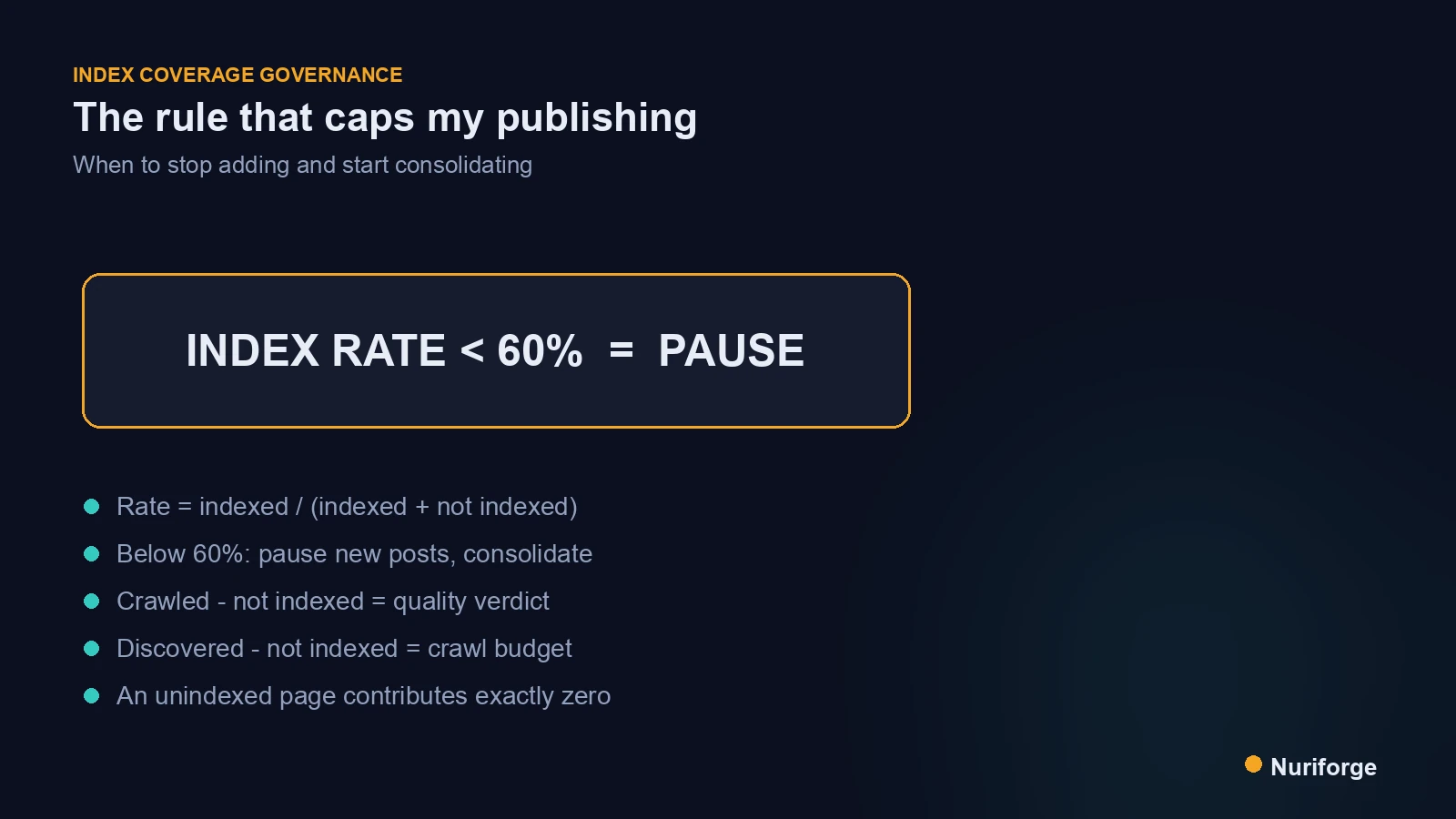
The metric is simple arithmetic on the page-indexing report: indexed pages divided by the sum of indexed plus not-indexed pages. If 200 URLs are indexed and 310 are not, your rate is roughly 39%. I ignore the raw counts and watch the ratio, because a site can grow its indexed count while its rate falls, and the rate is what tells you whether new work is being accepted or ignored. Google’s page-indexing report documentation explains what each status means and how to read the not-indexed breakdown, which is where the diagnosis actually happens.
One caveat keeps the number honest: not every not-indexed URL is a failure. Redirects, canonicalized duplicates, and deliberately excluded pages all show up as not indexed and are supposed to. So I compute the rate against pages I actually want indexed, subtracting the ones that are non-indexed by design. What is left — real articles Google chose not to keep — is the number that governs my publishing decisions.
Why low index coverage caps everything else
Every other SEO metric is downstream of indexing. Rankings, impressions, click-through rate, engagement — all of them require the page to be in the index first. An unindexed page scores exactly zero on all of them, which means a brilliant article that Google has not indexed is worth precisely as much as a blank one. That is why index coverage sits above everything in my monthly review: it is the gate every other number has to pass through.
Index coverage is the first number I refuse to read at face value; the second is impressions, which I take apart in High Impressions Versus Clicks: The AI-Overview Illusion (Coming soon).
This also reframes what a low rate is telling you. It is not a technical glitch to file a ticket for; it is Google declining to spend its limited attention on more of your pages until the existing ones prove their worth. Treating it as a quality signal rather than a bug changed how I respond. The answer to “Google won’t index my pages” is rarely “submit them harder” and usually “give it fewer, better pages,” a principle that runs through the content pipeline I run.
Triaging crawled versus discovered
The not-indexed breakdown has two rows I care about most, and they mean different things. “Crawled — currently not indexed” means Google visited the page, read it, and judged it not worth keeping. That is a quality verdict, and the fix is to make the page genuinely better or fold it into a stronger one. “Discovered — currently not indexed” means Google knows the URL exists but has not bothered to crawl it yet, which points at crawl budget and site trust rather than the individual page.
When a page has sat in the crawled bucket for weeks, I go through the per-URL fixes in How I Revive Crawled Not Indexed Pages in Search Console (Coming soon) before I count it as a loss.
Those two diagnoses lead to opposite actions, so conflating them wastes effort. A crawled-not-indexed page needs editorial work — more depth, more uniqueness, internal links from pages that already rank. A discovered-not-indexed pile needs the opposite of activity: slow down publishing so Google can catch up, and strengthen internal linking so the crawler has clearer paths, which is exactly the situation Google’s guidance on managing crawl budget is written for. I read each row, sort the affected URLs into “improve” or “wait,” and never apply one row’s remedy to the other’s problem.
What “stop publishing” actually means
Stopping does not mean stopping work; it means redirecting it. Instead of writing new articles, I spend the same hours consolidating thin pages into fewer strong ones, adding internal links from indexed pages to the ones stuck in the queue, and rewriting crawled-not-indexed pages until they earn their place. The output moves from breadth to depth. It is less satisfying because there is no shiny new URL to point at, but it is the work that actually raises the rate. In practice a single afternoon spent merging three weak pages into one strong one, and pointing a handful of indexed articles at it, moves the number more reliably than another week of fresh posts sitting untouched in the discovered pile.
| Index report status | What it means | Real problem or by design | What I do |
|---|---|---|---|
| Crawled — currently not indexed | Read but judged not worth keeping | Real quality problem | Improve depth or consolidate the page |
| Discovered — currently not indexed | Known but not yet crawled | Crawl budget / trust | Slow publishing, strengthen internal links |
| Duplicate / redirect / excluded | Non-indexed on purpose | By design | Exclude from the rate calculation |
| Indexed | Eligible to rank | Working | Protect it; link new work to it |
The rule I hold myself to is a rough threshold: if the real index coverage rate sits below about 60%, no new posts until it recovers. The exact percentage matters less than having a line I will not cross, because without one I will always find a reason to publish just one more.
When I let myself publish again
Resuming is earned, not scheduled. I start publishing again only when the rate has climbed back above my threshold and, ideally, when a batch of previously stuck pages has moved into the indexed column on its own. That second signal matters more than the first, because it shows Google’s willingness to accept my pages has genuinely recovered rather than just fluctuated. When both hold, I resume at a deliberately slow cadence — a couple of posts a week, not a backlog dump — and watch the rate after each one.
The point of the whole exercise is to keep publishing tied to the site’s actual capacity to get indexed, instead of to my appetite for producing. A content site is not rewarded for how much it publishes; it is rewarded for how much of what it publishes gets seen. Governing by index coverage is how I keep those two things from drifting apart.
FAQ
What is a good index coverage rate?
There is no official number, but on a small content site I treat anything below roughly 60% of the pages I want indexed as a signal to pause and consolidate. The trend matters more than the exact figure: a rate that is falling as you publish is the real warning.
How do I calculate my index coverage rate?
Take indexed pages divided by indexed plus not-indexed pages from the page-indexing report. Subtract URLs that are non-indexed by design, like redirects and canonicalized duplicates, so you are measuring only pages you actually want in the index.
What’s the difference between “crawled” and “discovered” not indexed?
“Crawled – currently not indexed” means Google read the page and judged it not worth keeping, so improve or consolidate it. “Discovered – currently not indexed” means Google knows the URL but hasn’t crawled it yet, which points at crawl budget and trust, so slow down and strengthen internal links.
Does an unindexed page hurt the rest of my site?
Yes, indirectly. A pile of unindexed pages signals low overall quality, which can make Google slower to index your new pages, including good ones. That is why publishing more when your rate is low often makes indexing worse, not better.
When should I start publishing again?
When the rate recovers above your threshold and some previously stuck pages have moved into the indexed column on their own. Then resume slowly, a couple of posts a week, and keep watching the rate after each one rather than refilling a backlog.
My Thoughts
The hardest part was emotional, not technical. Stopping felt like quitting, because output had been my proxy for effort, and effort is what I know how to give. Reading the index coverage number forced me to admit that a full queue was not the same as a growing site, and that I had been busy in a way that wasn’t working. Now I treat indexing as the site’s honest opinion of me, delivered without flattery. When it says “no more until these earn their place,” I have learned to listen instead of arguing with it by publishing harder.