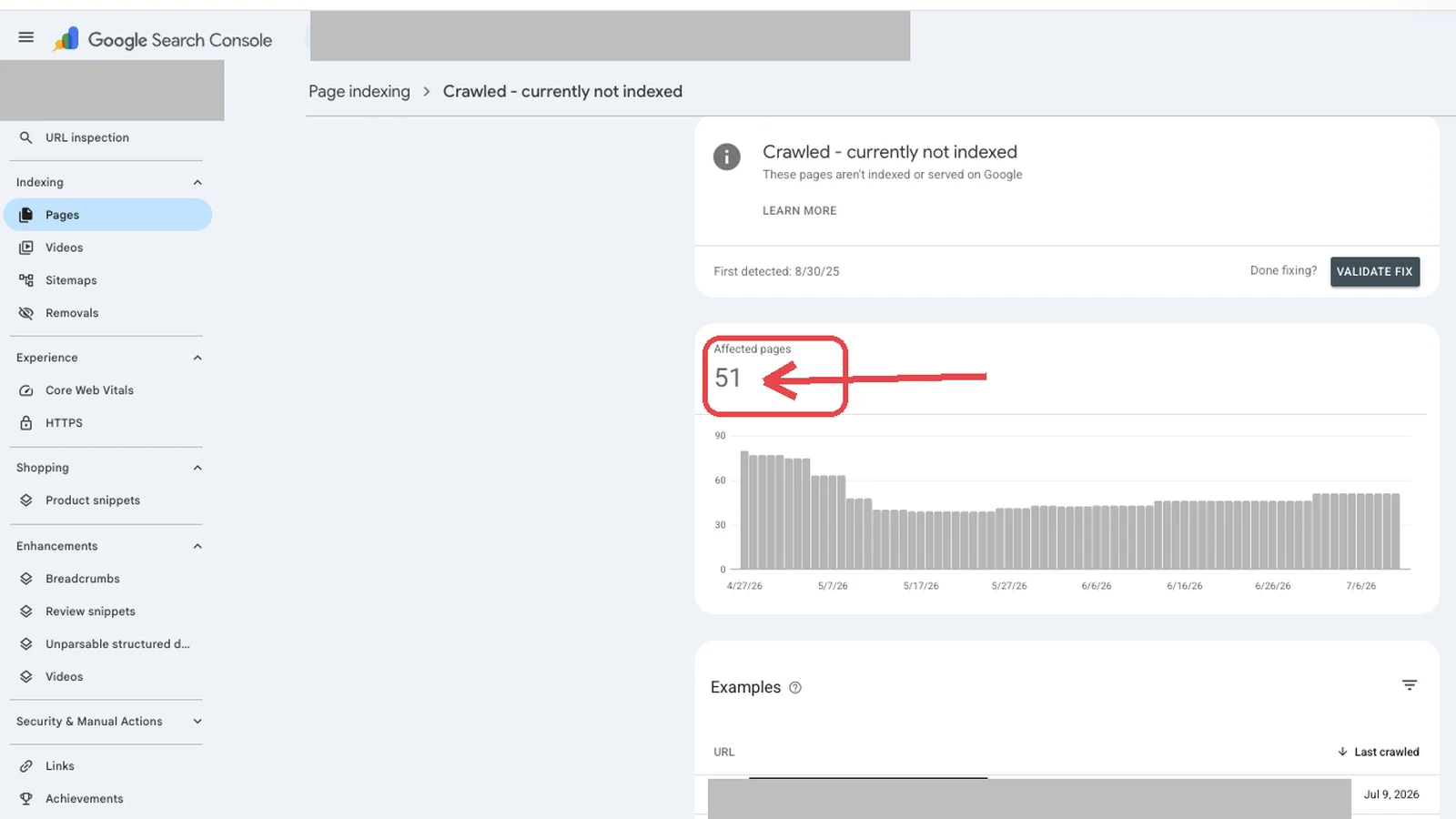
Google crawled 43 of my pages one month and decided none of them were worth indexing. On a Korea-travel affiliate site I run, a whole cluster sat under the same quiet verdict: fetched, read, and left out. Pages stuck as crawled not indexed aren’t a technical error you can patch — they’re a judgement that the page didn’t earn its place, and reviving them means changing that judgement. Here’s how I tell that state apart from its cousin, what actually moves a page from declined to indexed, and the order I work in.
What crawled not indexed actually means
In the Search Console page indexing report, “Crawled — currently not indexed” means Googlebot fetched the URL, looked at the content, and chose not to add it to the index. That last part is the whole story. Nothing is broken: the page loads, the markup is fine, the robots rules allow it. Google simply weighed the page and decided it wasn’t worth keeping, at least for now.
That reframes the fix completely. You’re not chasing a crawl error or a blocked resource; you’re trying to change a value judgement. Which means the levers are the things that make a page worth indexing — depth, uniqueness, and evidence that this URL matters — not another sitemap ping. Once I understood the label as an opinion rather than a fault, I stopped looking for something to repair and started looking for something to improve.
Two states people confuse: crawled versus discovered
The single most useful distinction here is between “crawled — currently not indexed” and “discovered — currently not indexed,” because they have almost opposite causes and almost opposite fixes. Crawled means Google read the page and passed on it. Discovered means Google knows the URL exists but hasn’t bothered to crawl it yet. Treat them the same and you’ll waste effort on the wrong lever every time.
Discovered-not-indexed is largely a crawl-priority problem: the fix is better internal linking, a cleaner site structure, and slowing your publishing so you’re not asking Google to crawl more than your site has earned. Crawled-not-indexed is a value problem: the page was seen and judged thin, duplicative, or redundant, so the fix is to make it genuinely better or to fold it into something stronger. Same report, two different jobs.
| Crawled — not indexed | Discovered — not indexed | |
|---|---|---|
| What happened | Google read it and passed | Google hasn’t crawled it yet |
| Root cause | Thin, duplicate, or low value | Crawl priority, weak linking |
| Primary fix | Improve, merge, or add evidence | Internal links, slower publishing |
| When to give up | Merge into a stronger page | Rarely — usually just needs links and time |
How I diagnose which pages to revive
Not every crawled not indexed page is worth reviving, so I triage before I touch anything. I pull the list from the page indexing report and sort each URL into one of three buckets: thin pages that never had enough substance, duplicate pages that overlap heavily with a stronger post, and genuinely good pages that got caught in a low-trust moment. The bucket decides the fix, and it saves me from rewriting a page that just needed a couple of links.
The tell for a duplicate is usually obvious once you look: two of my URLs targeting nearly the same intent, competing for the same query, neither strong enough to win. The tell for thin is that even I can’t say what the page offers that a reader couldn’t get faster elsewhere. And the tell for a good-but-ignored page is that it’s substantial and unique but poorly linked — often a newer post the rest of the site never pointed to. Diagnosis first, because the fixes below only work when they’re aimed at the right bucket.
The fixes that change Google’s judgement
For thin pages, the fix is depth the page didn’t have: real first-hand detail, specifics, evidence, the thing a reader can’t get from the ten pages already ranking. Padding won’t do it — Google already judged the shallow version, and re-serving the same shallow page with a few extra adjectives changes nothing. If I can’t add genuine substance, that’s a sign the page shouldn’t stand alone, and I move it to the merge pile instead of dressing it up. The bar I aim a rewritten page at is Google’s own guidance on creating helpful, people-first content: if it can’t clear that, more crawl requests won’t save it.
For duplicates, I pick the stronger URL, fold the useful parts of the weaker one into it, and redirect the loser to the winner. That consolidates the value into one page good enough to index rather than two too weak to earn it, and it stops my own URLs from competing with each other for the same query. The redirect matters as much as the merge: it hands whatever equity the weak page had to the survivor instead of leaving it stranded on a URL Google has already declined. This mirrors the last stage of the AI WordPress content pipeline I run, where a page that stalls gets strengthened or absorbed rather than abandoned.
For the good-but-ignored pages, the fix is connectivity: two or three internal links from my strongest, already-indexed posts, with anchors that actually fit the surrounding sentence. Those links do two jobs at once — they raise the page’s priority in Google’s eyes and give crawlers a real path to reach it. The one caveat is that the links have to be crawlable anchors, not JavaScript widgets or buttons; Google’s guidance on crawlable links is explicit that a link only counts when it’s a plain anchor with an href. A page that was substantial all along often just needed the rest of the site to admit it existed.
Requesting a recrawl without spamming it
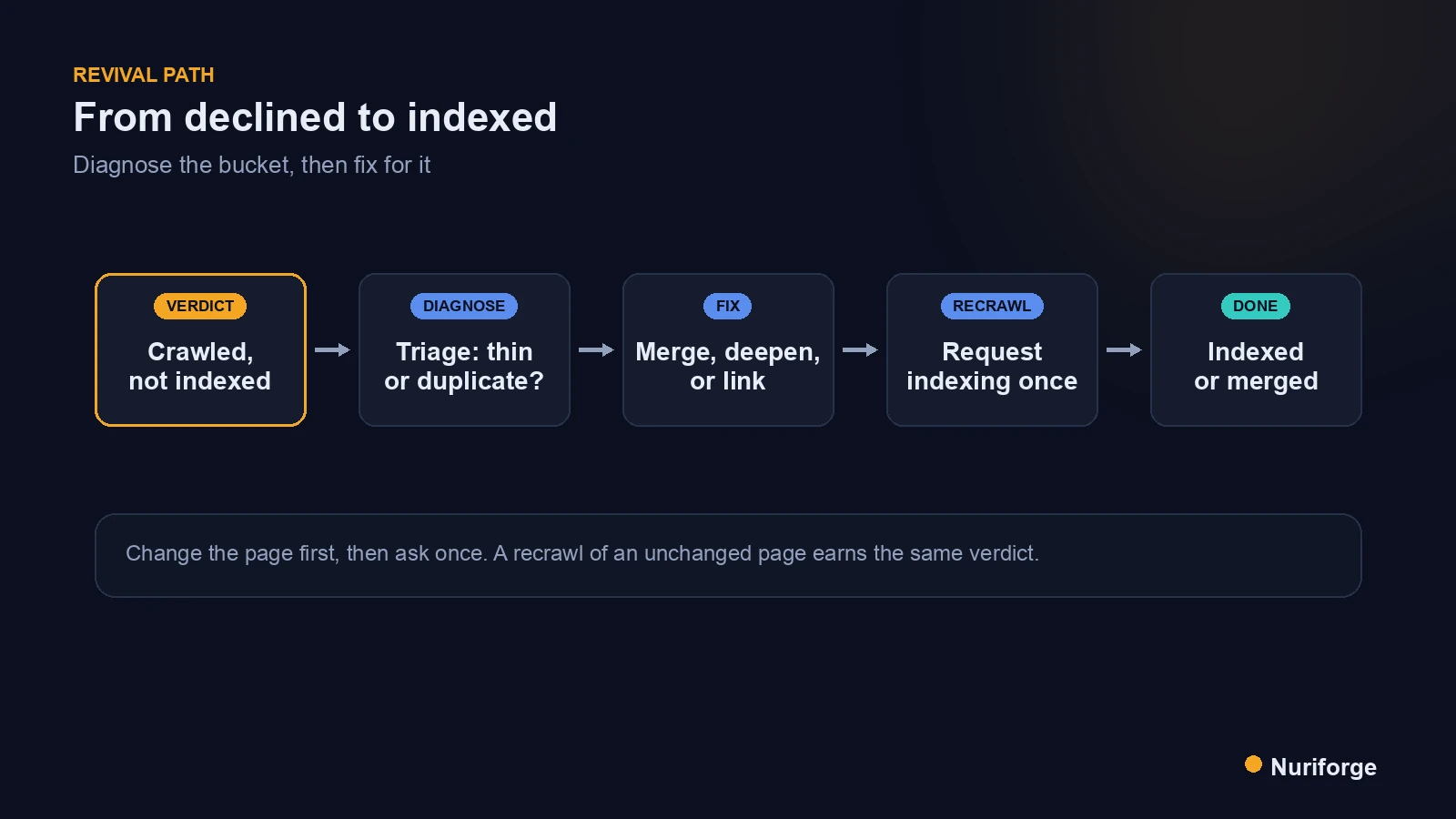
Once a page is genuinely improved or a merge is in place, I request indexing through the URL Inspection tool — once. The order matters: change the page first, then ask Google to look again, because a recrawl of an unchanged page just earns the same verdict. Requesting a recrawl before you’ve fixed anything is the most common wasted move I see, and it teaches you to mistake activity for progress.
Then I wait, because indexing decisions aren’t instant and re-requesting daily changes nothing. If the page was truly weak and I merged it, the redirect does its job whether or not the old URL ever indexes. If it was good and I strengthened its links, giving it a couple of weeks is fair. What I’ve stopped doing is hammering the recrawl button on a page I haven’t actually changed — persistence isn’t a quality signal, and Google’s decision was about the page, not about how many times I asked.
FAQ
Does crawled not indexed mean my page has an error?
No. It means Google fetched the page, read it, and chose not to index it. Nothing is technically broken — the page loads and the markup is fine. It’s a value judgement, so the fix is to make the page more worth indexing, not to patch a crawl error.
How is crawled not indexed different from discovered not indexed?
Crawled means Google read the page and passed, which points at thin or duplicate content. Discovered means Google hasn’t crawled the URL yet, which points at crawl priority and weak internal linking. The fixes are almost opposite, so identify which state you’re in before acting.
Will adding internal links fix a crawled not indexed page?
It helps if the page is genuinely good but poorly linked. Links from your strong, already-indexed pages raise its priority and signal that it matters. But if the page is thin or duplicative, links alone won’t change Google’s judgement — you have to improve or merge the content first.
Should I just delete crawled not indexed pages?
Not delete — consolidate. If a page is thin or duplicates a stronger one, merge its useful content into the stronger URL and redirect the weak one. That preserves any value and points Google at a single page good enough to index, which beats leaving two weak pages competing.
How long after fixing a page should I wait before re-requesting?
Improve the page first, then request indexing once, then wait a couple of weeks. Re-requesting a recrawl before you’ve changed anything just earns the same verdict, and requesting daily does nothing. The decision was about the page’s value, so change the page, ask once, and be patient.
My Thoughts
The mindset shift that fixed this for me was giving up the idea that crawled not indexed is a bug to squash. It’s feedback. Google read 43 pages and told me, page by page, which ones I hadn’t made worth keeping — and once I stopped arguing with that and started answering it, the report became a to-do list instead of a wall. Some of those pages came back after a real rewrite; more of them served me better folded into a stronger post. Either way, the page that gets indexed is the one you made undeniable, not the one you re-requested the most.