One page on a Korea-travel affiliate site I run showed 115,000 impressions at a 0.19% click-through rate, and my first instinct was that something was badly broken. It wasn’t. Reading impressions versus clicks as a single ratio hid what was actually happening: most of those impressions came from desktop searches where an AI Overview quoted the page and answered the question on the results page itself. No click was ever going to happen, and none was needed. This is how I now separate an AI-Overview mirage from a real click problem, and why the fix is usually to leave the strong page alone.
The number that looked like a disaster
A 0.19% click-through rate on a page with six figures of impressions reads like a page nobody wants. In the old mental model, that ratio means your title is failing or your snippet is repellent. So I almost did the reflexive thing: rewrite the title, rework the meta description, treat the page as sick. What stopped me was that this page had always performed well by every other measure — good engagement, returning readers, steady rank. A page that healthy does not suddenly develop a title problem overnight.
The mistake was treating impressions versus clicks as one blended number across every context the page appears in. That single ratio averages together situations that have nothing to do with each other: a mobile searcher looking for a page to read, and a desktop searcher whose answer was handed to them in an AI Overview before they ever considered clicking. Blend those and you get a meaningless number that panics you into fixing a page that isn’t broken.
Why desktop impressions get inflated
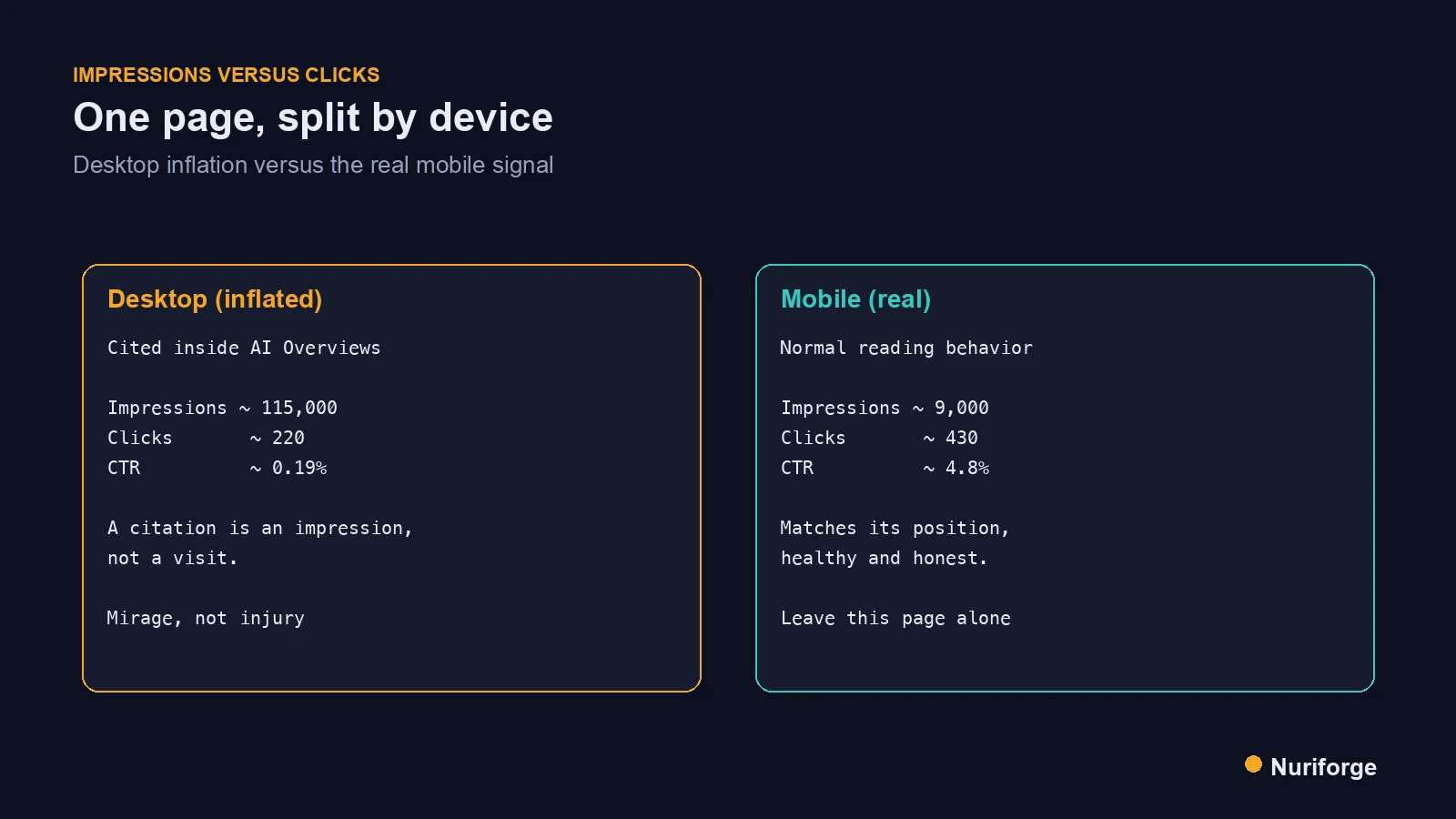
Here is the mechanism. When your page is cited as a source inside an AI Overview or a similar generative answer, Search Console counts that as an impression, because your URL did appear on the results page. But the searcher got their answer from the summary and had no reason to click through. So you accumulate impressions at scale with almost no corresponding clicks, and the ratio collapses — not because the page is weak, but because it was good enough to be quoted.
This effect is heavily skewed toward desktop, where these answer surfaces are more prominent and cover more query types. Google’s own documentation on AI features in Search describes how pages surface within these experiences, and the practical takeaway for a site owner is blunt: a citation is an impression, not a visit. Once I understood that, the six-figure impression count stopped looking like a failure and started looking like evidence the page was trusted enough to be the answer.
Reading impressions versus clicks by device
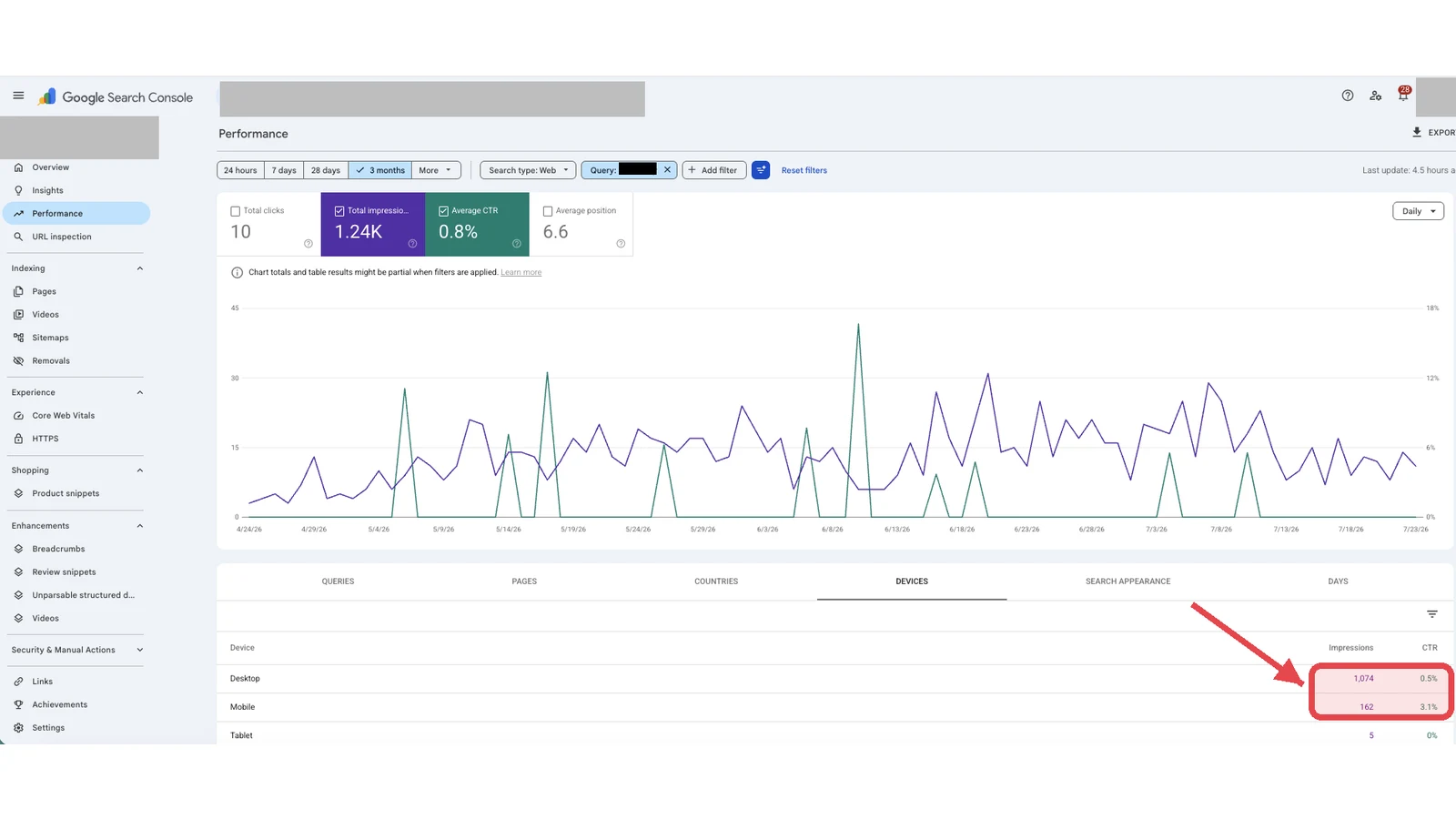
The fix for the misreading is to stop blending. In Search Console I split the same page by device and look at impressions versus clicks separately for mobile and desktop. On the page that scared me, desktop carried the enormous impression count and the near-zero click rate, while mobile showed far fewer impressions and a perfectly healthy click-through rate that matched its position. The mobile segment was the honest signal all along; the desktop segment was AI-Overview noise inflating the denominator.
That device split is the single most useful cut I make on this kind of page. The official Search Console documentation lets you segment by device and search appearance, and once you do, the two stories separate cleanly. If mobile CTR is fine and only desktop is dragging the average down, you are looking at inflation, not injury. If both devices show weak clicks against good positions, then you may genuinely have a snippet problem worth fixing.
Fact queries versus click-intent queries
Device is half the story; query intent is the other half. Some queries are factual — a date, a distance, a yes-or-no — and the results page can satisfy them outright, with or without an AI Overview. If your page ranks for a lot of those, it will collect impressions and few clicks by nature, because the search was answered before a click was on the table. That is not a content failure; it is the reality of ranking for questions that have short answers.
Click-intent queries are different. Someone searching for a full itinerary, a detailed comparison, or a how-to needs the page, because the answer does not fit in a snippet. Those are the queries worth competing for, and they are where a strong title actually earns clicks. So instead of trying to squeeze clicks out of fact queries that will never send them, I aim newer content at click-intent queries. This is the same prioritization logic I apply across the content pipeline I run: spend effort where a click is genuinely on offer.
When not to touch a strong page
The counterintuitive discipline is refusing to optimize a page that scary numbers say is broken. If a page has strong engagement, healthy mobile CTR, and stable rankings, then rewriting its title to chase a desktop ratio poisoned by AI-Overview impressions is how you break something that works. I have watched people tank a good page by “fixing” a metric that was never a problem, trading a title that earns clicks on mobile for one tuned to a number that only exists because a summary box quoted them.
My rule now is simple: a blended low CTR is a prompt to investigate, never a verdict to act on. Segment first, understand which context is producing the number, and only touch the page if a real click-intent segment is underperforming. More often the right response to an inflated impression count is to do nothing to that page and put the energy somewhere a change can actually move traffic.
What I actually do with an inflated page
When I confirm a page is inflated rather than injured, I treat the impression count as a signal about the topic, not a to-do about the page. Being quoted at scale tells me the subject has demand and that my coverage is trusted, so the productive move is to build adjacent click-intent pages around it — the detailed itinerary next to the quick fact, the full comparison next to the one-line answer. The inflated page becomes a hub that lends its trust to pages that actually capture clicks.
| What you see | Likely cause | Real or mirage | What to do |
|---|---|---|---|
| Huge desktop impressions, near-zero CTR | AI-Overview citation | Mirage (inflation) | Leave the page; build click-intent pages nearby |
| Healthy mobile CTR at same position | Normal reading behavior | Real, and fine | Nothing — the page works |
| Low CTR on both devices, good rank | Weak title or snippet | Real problem | Rewrite title and meta description |
| Impressions for fact queries only | Answer fits in the SERP | Real, expected | Target click-intent queries instead |
The whole reframe comes down to refusing to average away the context. Impressions versus clicks is not one number; it is several stories stacked on top of each other, and your job is to separate them before you decide anything.
FAQ
Why does a page have high impressions but almost no clicks?
Usually because it is being cited in an AI Overview or answering a factual query directly on the results page. Search Console counts the appearance as an impression, but the searcher got their answer without clicking. The low ratio reflects the SERP context, not a weak page.
Do AI Overviews count as impressions in Search Console?
Yes. If your URL appears as a source within an AI Overview, that registers as an impression even though most searchers won’t click through. This inflates your impression count and drags down your average click-through rate, especially on desktop.
Should I rewrite the title of a low-CTR page?
Only after you segment. If mobile CTR is healthy and only desktop is dragging the average down, the page is inflated, not broken, and rewriting the title can hurt it. Rewrite only when a real click-intent segment underperforms on both devices.
How do I tell inflation from a real click problem?
Split the page by device and by search appearance in Search Console. Inflation looks like huge desktop impressions with near-zero clicks while mobile stays healthy. A real problem shows weak clicks against a good position on both devices.
What should I do with an inflated page?
Treat the impression count as proof the topic has demand and your page is trusted. Instead of fixing the page, build adjacent click-intent pages, such as detailed guides or comparisons, that capture the clicks a short answer never will.
My Thoughts
What this changed in me was smaller than a tactic and bigger than a metric. I stopped trusting blended averages, full stop. A number that combines contexts you would never combine in your head is a number designed to mislead you, and impressions versus clicks is the clearest example I have run into. The page that looked like my worst performer was quietly one of my most trusted, and I nearly broke it to satisfy a ratio. Now, before I act on any alarming number, I ask what it is actually made of — and often the honest move is to leave the strong page exactly as it is.