The interesting part of an AI content pipeline isn’t the AI. It’s the human in the loop — the point where a person reads a machine’s draft, decides what’s actually true, and puts their name on what ships. The model can outline, draft, and format faster than I ever will. What it can’t do is take responsibility, and responsibility is the entire reason a content site is worth trusting. This is where I keep that person in the process, what they own that no model touches, and what breaks the moment you take them out.
What a human in the loop actually does
A human in the loop is not a proofreader who fixes typos after the fact. It’s a gate: nothing reaches the live site until a person has read the draft, verified its claims against something real, and chosen to stand behind it. The distinction is the difference between editing and approving. A proofreader improves what’s there. A gatekeeper can also say no, send the whole draft back, or throw it out because the underlying idea was thin.
That veto is the part that matters. When a model writes a confident paragraph about a command flag that doesn’t exist, or a benchmark it half-remembers, the fix isn’t a smoother sentence. The fix is a person who has run that command, knows the flag is wrong, and refuses to let the paragraph out. The model supplies fluency. The human supplies the one thing fluency can’t fake, which is having actually done the thing being described.
So the job of the person in the loop is narrow and non-negotiable: confirm it’s true, confirm it’s useful, confirm it’s mine to publish. Everything the machine is good at — structure, pace, tidy HTML — happens around that decision, not instead of it.
Where the review gate sits in the pipeline
Placement is everything. A review that happens too early reads an outline no one will publish; a review that happens too late is rubber-stamping a post that’s already been scheduled. In my pipeline the human gate sits in exactly one place: after the machine has produced a complete, formatted draft, and before anything is allowed to reach WordPress. One gate, one moment, no ambiguity about when the person is on the hook.
That single position does a lot of work. It means the model can do its full job first — research, draft, wrap the tables, build the schema — so the person isn’t wasting attention on formatting that a script handles better. It also means the review is the last thing that happens before publishing, so there’s no window afterward where a “final” automated step can quietly change what was approved. The person reads the actual bytes that will go live, not an earlier version of them. The automated stages around that gate have their own ways of reporting success while doing nothing, and I catalogued those in When a Pipeline Fails Silently: Four Modes, Four Guards.
I treat that gate the same way the rest of the content pipeline I run treats its automated checks: as something the process cannot skip. The machine’s steps are ordered so the draft arrives at the gate finished, and the gate is the only door to the live site.
The judgment calls I never hand to a model
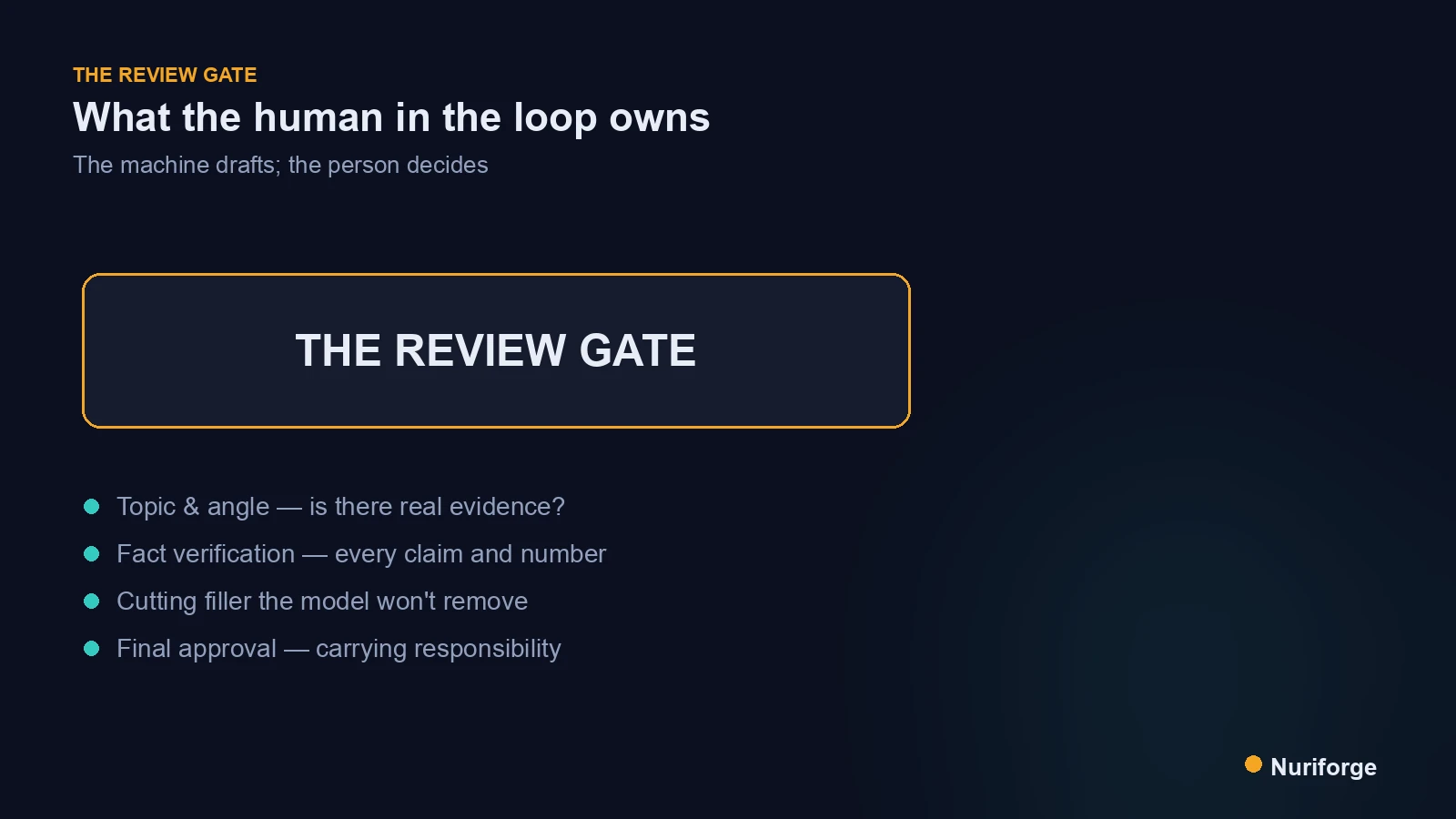
Keeping a person in the loop only helps if it’s clear what that person decides. Vague ownership produces the worst of both worlds: a human who feels responsible but defers to the model anyway. So I write the split down. There are four decisions I never delegate, because each one depends on experience the model doesn’t have and can’t acquire from a prompt.
The first is the topic and the angle — whether I have genuine first-hand evidence for this piece, or I’m about to write around a hole. The second is factual verification: every command, number, and screenshot gets checked against the real thing, not against the model’s confidence. The third is cutting, because a model pads and a person who values the reader’s time removes. The fourth is final approval, the literal decision that this is good enough to carry my name.
| Decision the human owns | Why a model can’t own it | What breaks if you skip it |
|---|---|---|
| Topic & angle | It requires real, first-hand evidence to exist | Confident writing about things you never did |
| Fact verification | The model is fluent, not accountable | Plausible details that are quietly wrong |
| Cutting filler | Models pad; they rarely subtract | Long posts that waste the reader’s time |
| Final approval | Only a person can carry responsibility | Publishing you’d disown if asked about it |
Notice that none of these are about writing prettier sentences. They’re about truth, restraint, and accountability — the parts of publishing that were never really a writing problem. That’s why I’m comfortable letting the model do the drafting: the decisions I actually care about were never the ones it was going to make.
What goes wrong the moment you remove the person
You can watch the failure mode in the wild. Take the same capable model, remove the review gate, and point it at a keyword list, and it will produce hundreds of articles that are grammatical, structured, and hollow. Nothing in them is exactly a lie; nothing in them is exactly earned either. It’s writing that has read about the topic but never touched it, at a volume no human could have checked.
That’s the trap, and it’s a quiet one, because each individual post looks fine in isolation. The damage is cumulative. A site full of competent, evidence-free pages reads to a search engine as exactly what it is: content produced to fill a template rather than to help a person. The missing ingredient isn’t quality of prose. It’s that no one with judgment ever decided any of it was worth publishing.
I’ve felt the pull toward this even inside a careful pipeline. The model can produce far more drafts than I can review, and the tempting move is to loosen the gate to keep up. Every time I’ve been tempted, the answer has been to publish less, not to review less. The gate is the product. Widening it to ship more is removing the only thing that made the output trustworthy.
The line between AI-assisted and scaled abuse
Google has been explicit that it doesn’t penalize AI writing as such. What it penalizes is content produced at scale to manipulate search rankings, regardless of how it was made. That policy is precise, and the human in the loop is exactly what sits on the right side of it. A person choosing topics they have evidence for, verifying facts, and approving each post is the difference between assistance and abuse.
The useful thing about framing it this way is that it turns a fuzzy fear (“will AI content get me penalized?”) into a concrete test. Could you defend every published post as something you stand behind, informed by real experience, meant to help the reader in front of it? If yes, the method doesn’t matter. If you can only defend the volume, you’ve already crossed the line the policy is drawing.
Google’s guidance on creating helpful, people-first content reads, to me, like a description of what a good review gate enforces: demonstrated first-hand expertise, real value, and content made for people rather than for the algorithm. You don’t need a secret technique to pass it. You need a person willing to reject the drafts that don’t clear that bar.
Keeping the review gate from becoming the bottleneck
The honest objection to all of this is throughput. If a person has to read and approve every post, isn’t the human just a bottleneck that erases the point of automating anything? In practice, no — but only because the machine is arranged to protect the human’s attention rather than compete for it. The person should never spend a second on work a script does better.
So everything mechanical happens before the gate and stays invisible to it. Tables get wrapped, schema gets minified and validated, links get checked, the structure gets built — all automatically, so the draft that reaches me is already clean. My review is spent entirely on the four judgment calls, not on hunting for a missing table wrapper. That’s the trade: automate ruthlessly right up to the edge of judgment, then stop and let the person decide.
The other half is pace. A review gate only bottlenecks a pipeline that’s trying to publish faster than it should. Since a new site can’t be indexed faster than a steady trickle anyway, the throughput the gate allows is already more than the throughput the site can use. The bottleneck was never the human. It was the assumption that more posts is the goal.
FAQ
What does “human in the loop” mean for an AI content pipeline?
It means a person reviews and approves every draft before it’s published, with the authority to reject it entirely. The AI drafts and formats; the human verifies the claims, cuts filler, and takes responsibility for what ships. It’s an approval gate, not a proofreading pass.
Doesn’t a human reviewer defeat the point of automating content?
No, because the automation targets the mechanical work, not the judgment. Research, drafting, formatting, and validation run automatically, so the person spends their attention only on truth, cutting, and approval. You automate everything up to the edge of a real decision, then stop.
Will keeping a human in the loop protect me from Google penalties?
It’s the strongest protection there is. Google penalizes content produced at scale to game search, not AI use itself. A person choosing evidence-based topics, verifying facts, and approving each post is exactly what keeps a site on the helpful-content side of that policy.
What specifically should the human review, versus the machine?
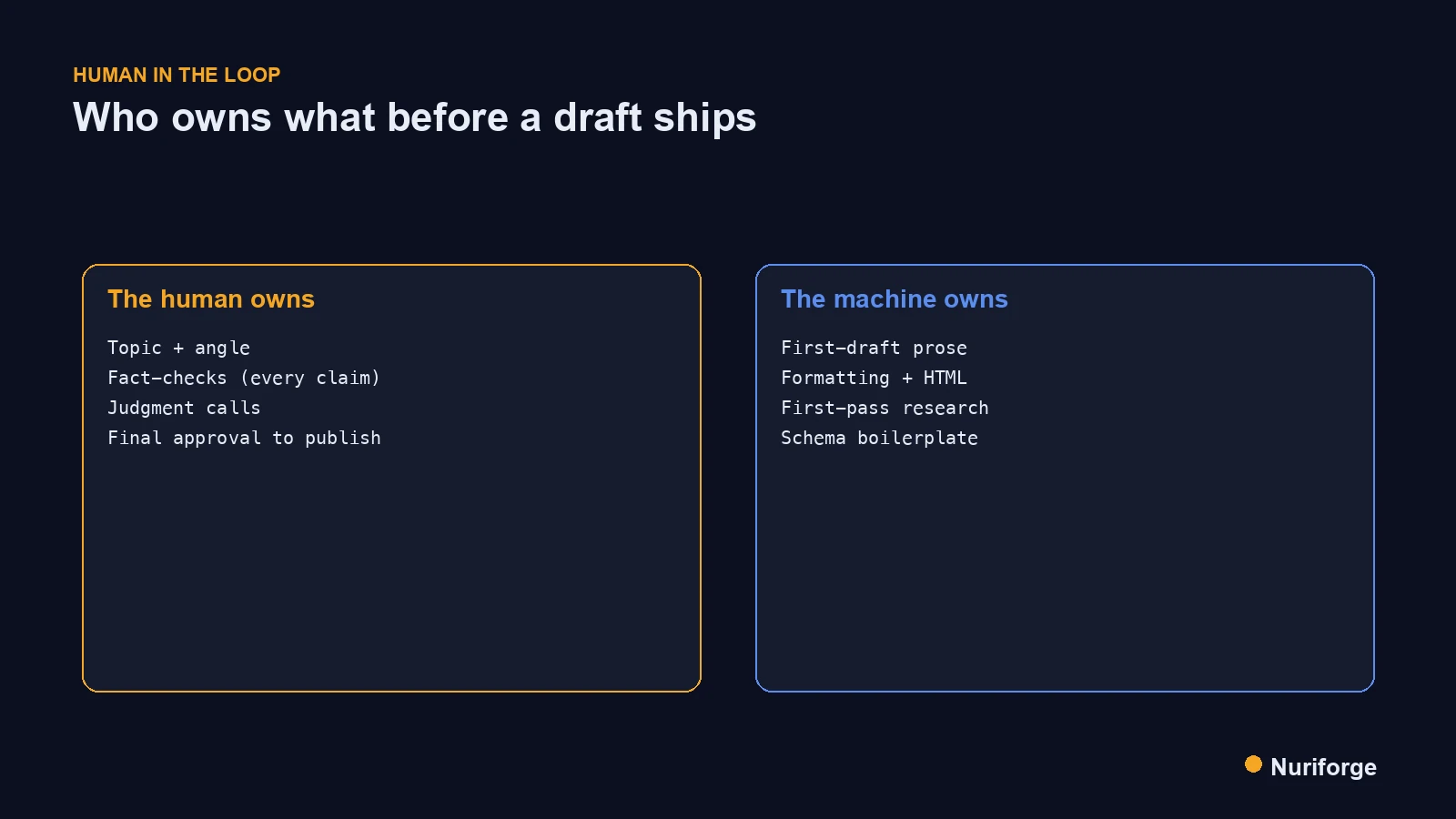
The human owns four calls: the topic and angle, factual verification, cutting filler, and final approval. The machine owns outlining, first drafts, formatting, schema, and link checks. If a step needs experience or accountability, it stays human; if it’s repeatable, automate it.
How do I stop the review step from slowing everything down?
Move all mechanical work before the gate so the draft arrives clean, and slow your publishing pace to match how fast a site can actually be indexed. The gate only feels like a bottleneck when you’re trying to publish more than a site can absorb.
My Thoughts
I’ve come to think of the model as the fastest junior writer I’ve ever worked with, and myself as the editor who signs off. It drafts tirelessly and formats perfectly and has never once, on its own, decided that a post wasn’t worth publishing. That decision is mine, and I’ve stopped trying to automate it away. The pipeline earns its keep by handing me finished drafts and clean formatting; it earns its trust by never publishing one I didn’t choose. Keep the machine on the mechanical work, keep yourself on the calls that need a spine, and the loop holds.