You can’t fake experience, so I stopped trying to write around it. For a while I treated E-E-A-T as a tone problem — sound confident, sound authoritative, sound like someone who’s done the work. It doesn’t hold up, because a reader and a search engine can both tell the difference between describing a thing and having done it. What actually works is boring: collect real evidence first, then write from it. This is the system I use to make sure every post rests on something I can show — a screenshot, a log, a line of code — rather than a confident voice papering over a gap.
Why you can’t write your way around missing experience
The tell of experience-free writing is that it stays general. It explains what a tool is for, lists its features, and offers advice that could have been assembled from the tool’s own homepage. What it never does is tell you the specific thing that only happens once you’ve actually used it — the flag that behaves differently than the docs say, the number that surprised you, the step that failed the first time.
Those specifics can’t be reasoned into existence. You either hit the problem or you didn’t. A model can write a fluent paragraph about a workflow it has never run, and it will read fine until someone who has run it notices that all the load-bearing details are missing. That gap between smooth and true is exactly what generic content can’t cross, no matter how polished the prose gets.
So the honest conclusion is to stop trying. Instead of writing around a gap in experience, I treat the gap as a signal: if I can’t produce a receipt for a claim, that’s a topic I shouldn’t be writing yet, not a paragraph I should make sound more assured.
What E-E-A-T rewards, in plain terms
Stripped of the acronym, E-E-A-T — experience, expertise, authoritativeness, trust — is Google’s way of asking whether a page was made by someone who actually knows the subject firsthand. Google’s own guidance on creating helpful, people-first content frames it as a set of questions you ask about your own page: does this demonstrate first-hand experience, does it come from evident expertise, would you trust it? Those are not questions you answer with tone. You answer them with proof.
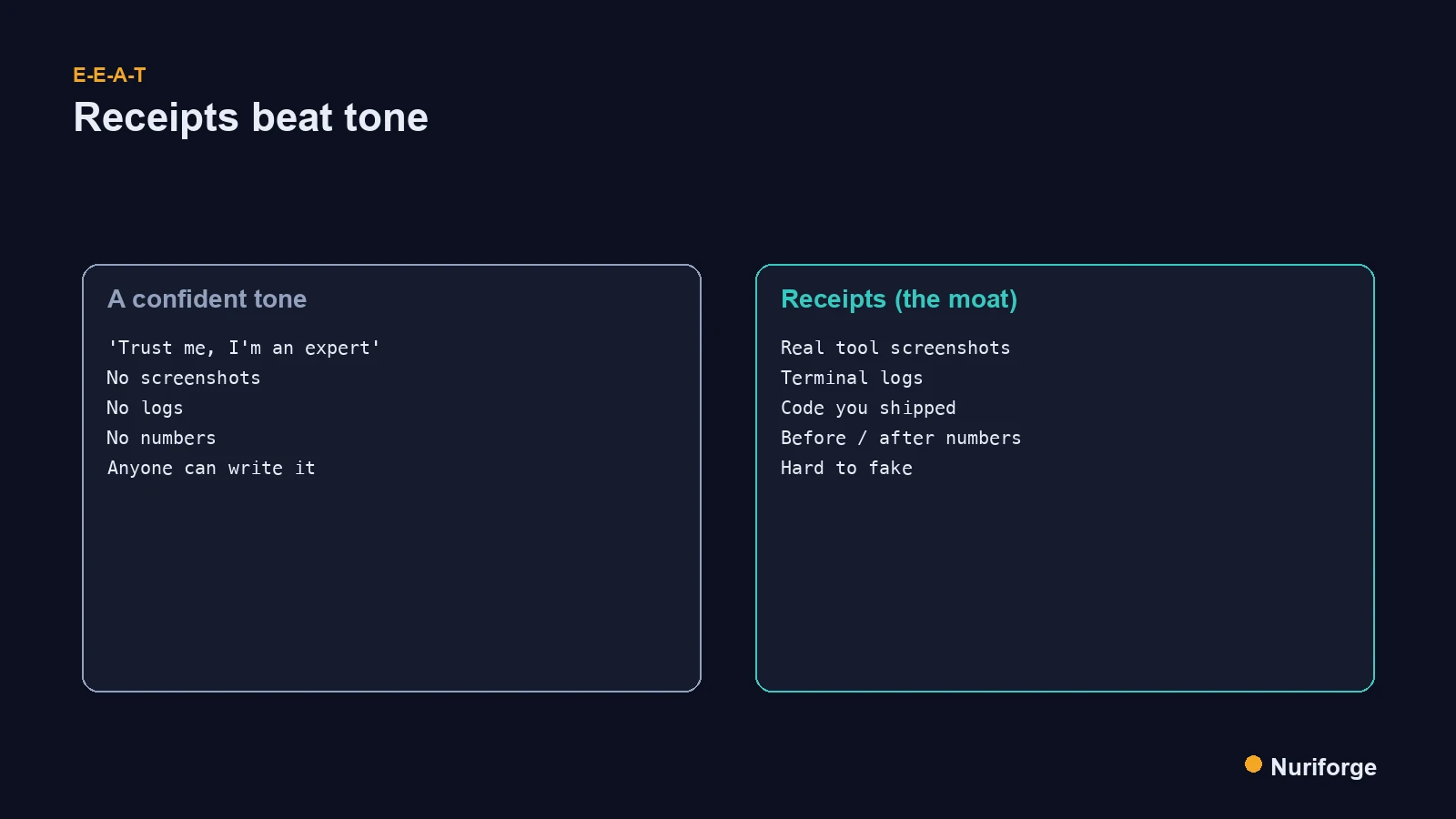
The word that matters most in that list is the extra E: experience. It’s the one you cannot borrow from a source or infer from a spec sheet. Expertise can be studied; authoritativeness accrues over time; but experience is binary — you did the thing or you didn’t. That’s why it’s the hardest to fake and, when you have it, the most valuable to show.
Reading E-E-A-T this way turns it from a mysterious ranking factor into a concrete instruction. Don’t perform authority; document it. Every one of those four letters is easier to satisfy when the page carries visible evidence that a real person did real work, which is what the rest of this comes down to.
Receipts: the four kinds of evidence I collect
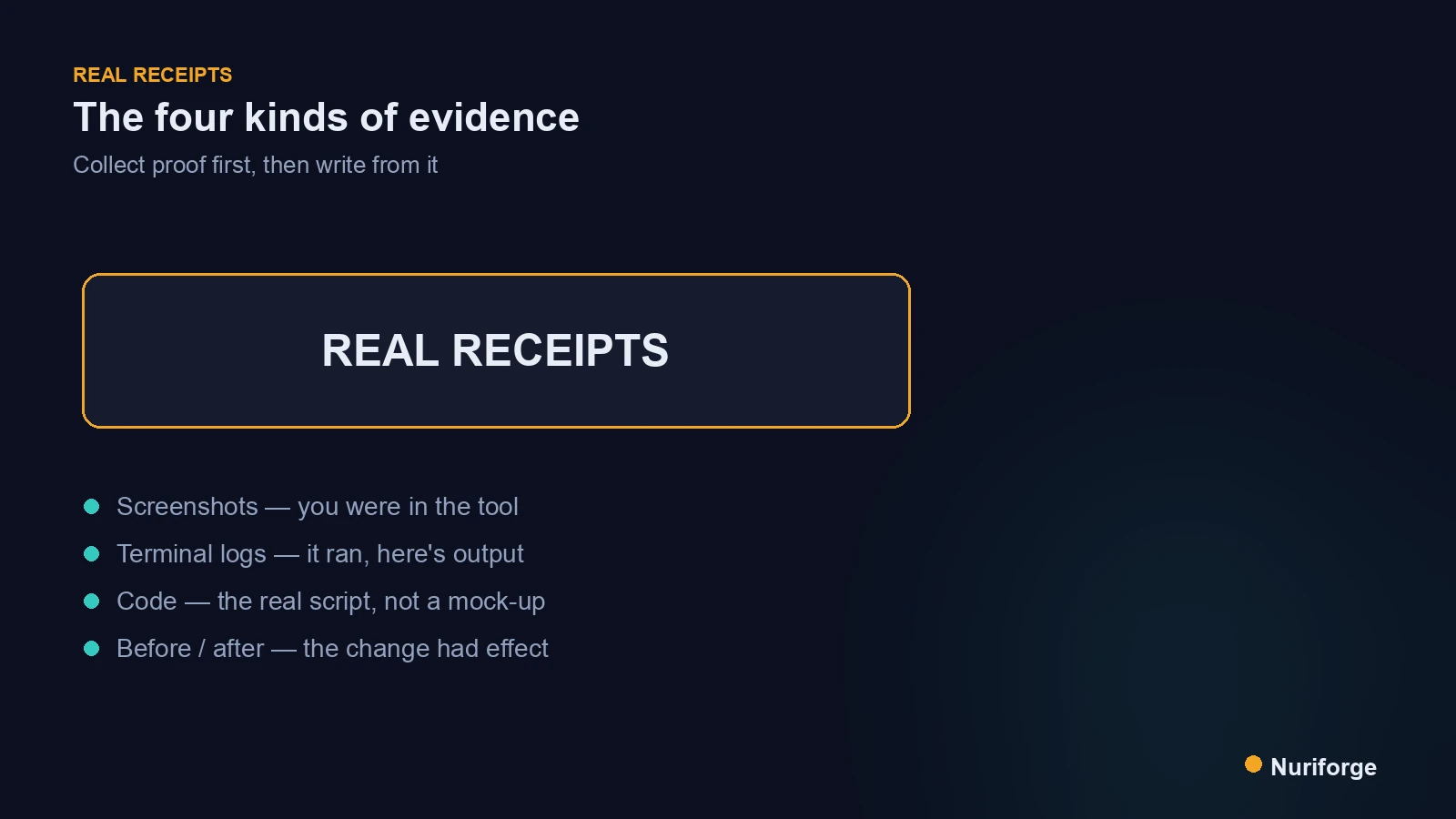
I call the proof a post rests on its receipts, and there are four kinds I actually collect. Naming them matters because “add evidence” is too vague to act on, while “which of these four do I have for this claim?” is a question I can answer before I write a word. Each kind proves something the others don’t.
Screenshots of a real interface prove I was in the tool: a dashboard, an editor, an actual error message. Terminal logs prove a thing ran and what it returned, which is far more convincing than a paraphrase of what it “should” do. Code — the actual script, not a sanitized snippet — proves the mechanism exists as described. And before-and-after pairs prove a change had an effect, which is the whole point of most how-to writing. Together they’re the difference between telling and showing.
| Receipt type | What it proves | Typical example |
|---|---|---|
| Screenshot | You were actually in the tool | A dashboard, editor, or real error |
| Terminal log | Something ran and returned this | Command output, a test result |
| Code | The mechanism exists as described | The real script, not a mock-up |
| Before / after | A change had a measurable effect | Broken layout vs fixed, counts moving |
One rule sits over all four: a receipt gets masked before it’s published, never faked. Real screenshots have their secrets — keys, private domains, customer data — blacked out, and that’s the only editing allowed. The moment you’d have to invent a receipt instead of masking a real one, you’ve left the honest side of this entirely, and the value is gone.
Writing evidence-first, not evidence-last
The ordering is what makes this an engine rather than a wish. Most writing advice treats evidence as something you add at the end, hunting for a screenshot to justify a paragraph you’ve already written. I flip it. The evidence comes first: before drafting, I gather the receipts a topic needs and store them, and only then do I write from what I actually have. As part of the content pipeline I run, each post has an evidence folder that gets filled before the prose does.
Working this way changes what gets written. When the receipts come first, the article is shaped by what I can prove, so the experience-heavy sections are grounded by default and the ratio stays honest — roughly two-thirds lived detail to one-third reference material. When evidence comes last, the article is shaped by what sounds good, and you spend the end scrambling to justify claims you’d have been better off not making.
It also makes the human review easier, because the reviewer isn’t asked to trust a confident draft — they’re asked to check it against the receipts sitting next to it. A claim either has a screenshot behind it or it doesn’t. Evidence-first turns “is this true?” from a judgment call into a lookup.
What to do when you don’t have a receipt
The awkward case is a topic you want to cover but can’t fully prove. The wrong move — the one E-E-A-T is designed to catch — is to invent the missing experience and write it as if it happened. That’s not a gray area; it’s the exact thing that turns a useful site into a liability the first time a reader with real knowledge shows up.
The right move is to switch registers honestly. Where I have direct experience, I write in the first person about what I did and what it cost. Where I only have general knowledge, I say so plainly — “the documentation describes it this way” or “typically you’d expect” — and cite the source instead of dressing up secondhand information as firsthand. Readers don’t punish honesty about the limits of your knowledge; they punish being misled.
Often the cleanest answer is simply not to write the post yet. A gap in evidence is useful information: it tells you where your real experience ends. I’d rather publish fewer posts that each carry a receipt than a full calendar of confident pieces I couldn’t stand behind if questioned. Scarcity of proof is a reason to wait, not a reason to improvise.
Why real evidence is the only durable moat
There’s a strategic reason to obsess over this beyond passing a quality check. Anything that can be assembled from public information can be assembled by everyone, including large sites and AI-generated summaries, and it will be. Generic how-to content is the most competitive, least defensible ground there is. The only thing that can’t be copied is what you specifically did — your screenshots, your logs, your before-and-after.
That’s the moat. A competitor can restate the same facts, but they can’t produce your terminal output from the time your batch job broke, or the dashboard from the project you actually shipped. Firsthand evidence is non-fungible in a way that facts simply aren’t, which is why a site built on it holds up even as the surrounding topic gets commoditized. It aligns exactly with what Google’s search guidance keeps pointing at: content that demonstrably comes from doing, not just reading.
So the evidence engine isn’t only a way to satisfy a ranking system. It’s a way to write things other people can’t, which is the only content strategy that gets stronger rather than weaker as AI makes generic writing free. Spend the effort where it can’t be copied.
FAQ
What does E-E-A-T actually stand for and mean?
Experience, expertise, authoritativeness, and trust. In plain terms it’s Google’s way of asking whether a page was made by someone who genuinely knows the subject firsthand. The added “experience” is the hardest to fake, because you either did the thing or you didn’t, and it can’t be inferred from a spec sheet.
Can you improve E-E-A-T just by writing more authoritatively?
No. Tone doesn’t create experience, and both readers and search engines can tell the difference between describing something and having done it. Experience-free writing stays generic; it never surfaces the specific details that only come from actually using a tool. You improve E-E-A-T with visible proof, not a confident voice.
What counts as real evidence in a blog post?
Four kinds: screenshots of a real interface, terminal logs showing what ran, the actual code behind a method, and before-and-after pairs proving a change had an effect. Each proves something a confident paragraph can’t. Receipts get masked to hide secrets before publishing, but they are never faked.
What should I do if I don’t have first-hand experience with a topic?
Switch registers honestly: write firsthand where you have experience, and where you don’t, say so and cite a source instead of dressing up secondhand information as your own. Often the best answer is to not publish that post yet. A gap in evidence tells you where your real experience ends.
Why is first-hand evidence a competitive advantage, not just an SEO checkbox?
Because anything assembled from public information can be assembled by everyone, including AI summaries, so generic content is the least defensible ground there is. Your specific screenshots, logs, and results can’t be copied. Firsthand evidence is the one moat that gets stronger as generic writing becomes free.
My Thoughts
The shift that made the biggest difference wasn’t learning to write better sentences about things I half-knew. It was accepting that the sentences were never the problem. When a post feels thin, the fix is almost never in the prose — it’s that there was nothing real underneath it to write about. Collecting the receipt first, and being willing to skip the topic when there isn’t one, quietly solved a problem I used to try to solve with adjectives. Show the work, mask the secrets, and let the evidence do the arguing.