A front-end sweep of my site checked every live post for broken markup and came back clean, yet it had still missed forty posts. That gap is the whole problem with structured data validation that only reads public URLs: a post scheduled to publish next Tuesday has no page for a crawler to open, so nothing checks it until it is already live and already wrong. The fix isn’t a better crawler. It’s reading each post’s stored markup directly, in both states, and parsing every block myself. Here is the check I run, why the front-end version has a blind spot, and how to cover published and scheduled posts in a single pass.
Why front-end structured data validation misses scheduled posts
Most validation advice assumes there is a page to look at. You point a tool at a URL, it fetches the HTML, it reads the structured data, it tells you whether the markup is valid. That works fine for anything already public. It breaks the moment a post is queued rather than live, because a scheduled post has no front end at all. There is no URL for a crawler, no HTML for a tool to fetch, and therefore nothing for a front-end sweep to validate. The check has to read the stored content through the API instead, using the same edit context I rely on to edit live WordPress posts safely.
This is exactly why my clean sweep lied to me. Every published post really was fine, so the report was accurate about what it could see. What it could not see was the queue: dozens of posts sitting behind the scenes with the same markup, waiting to go out on a schedule. If a batch operation had corrupted the schema on the live posts, it corrupted the queued ones too, and the sweep had no way to know. A validation that only reads public URLs isn’t wrong so much as incomplete, and the incompleteness is the size of everything you haven’t published yet.
Read the stored markup, not the rendered page
The move that fixes the blind spot is to stop treating the public page as the source of truth and start reading what WordPress has actually stored. Every post, live or scheduled, keeps its content saved in the database the instant you hit publish or schedule. That stored markup is readable through the WordPress REST API long before any front end exists, and it is the version that will eventually render, byte for byte.
Reading the source instead of the render has a second benefit that matters more than the scheduled-post fix. The rendered page can hide problems: a browser is forgiving, and a slightly malformed block might still display without a visible error. The stored markup shows you precisely what the machine will try to parse, with none of the browser’s tolerance in the way. When you pull the raw content and read the schema block directly, you are looking at the same bytes a crawler will choke on, not a cleaned-up approximation of them. Diagnose from the stored content, and both the scheduled-post gap and the false-clean render close at once.
Cover published and scheduled in one pass
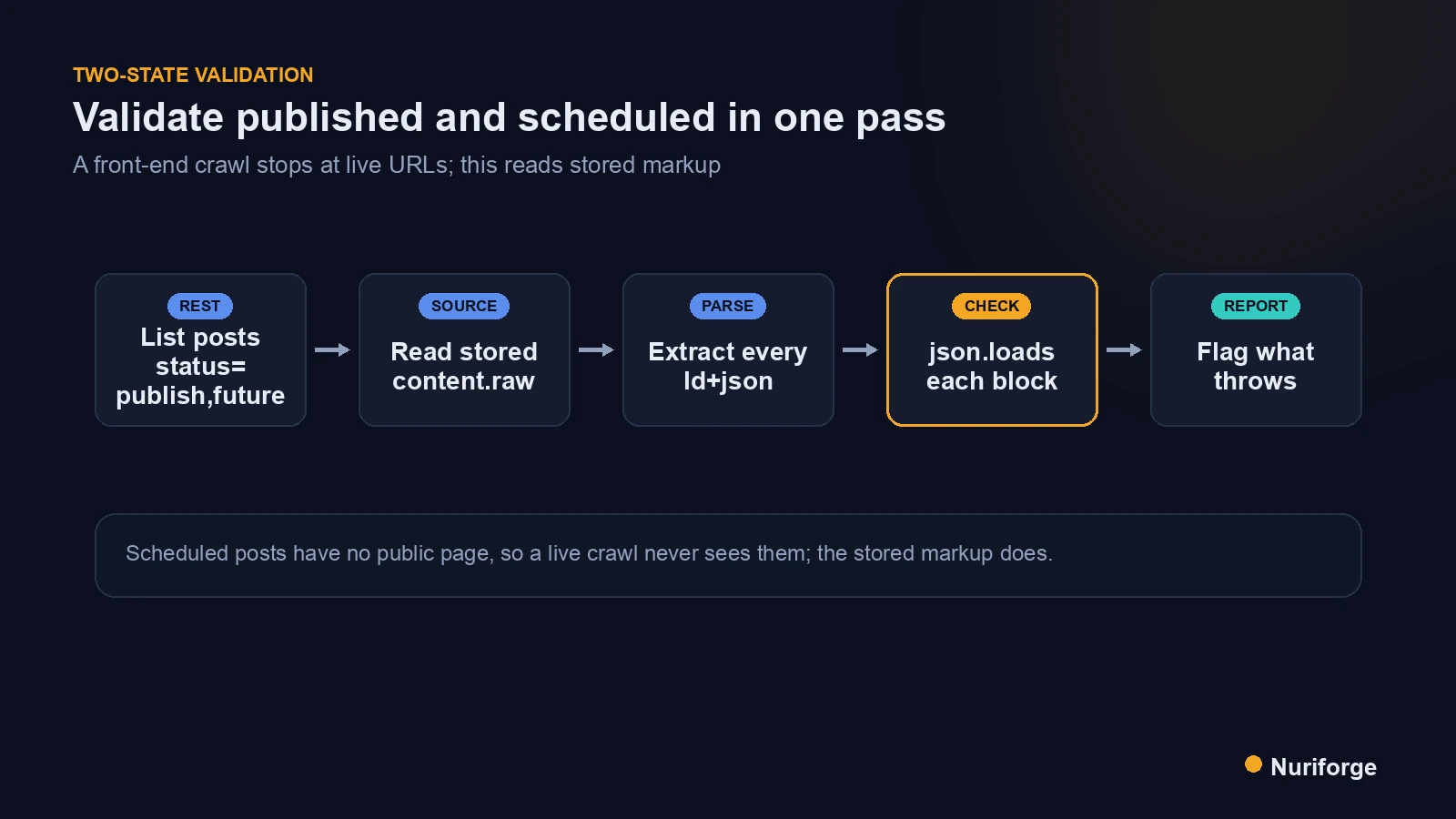
The whole point of doing this through stored content is that one query can span every state at once. When I list posts to validate, I ask for both the published and the scheduled sets together rather than iterating over live URLs. In REST terms that means requesting posts with a status of publish and future in the same call, so nothing in the queue is invisible to the scan. A scheduled post carries the status future until its date arrives; ask only for publish and you have quietly excluded your entire pipeline.
Running both states through the identical parser is what makes the check trustworthy. There is no separate “scheduled validator” and “live validator” to keep in sync, no second code path that might drift. Every post, regardless of when it goes out, gets its stored markup pulled and its schema blocks parsed the same way. That uniformity is the difference between a check you believe and a check that happens to agree with a crawler on the posts the crawler could reach. It also means a corrupted batch shows up before the scheduled posts publish, while there is still time to fix them quietly.
Parse every block, don’t eyeball it
Once you have the stored markup, the temptation is to read it and decide it looks fine. Don’t. Structured data fails in ways that are invisible to a quick human scan: a tag injected mid-string, an unescaped quote, a trailing comma, a value that should be a number sitting in quotes. Your eyes will slide right over a stray <br /> buried inside a long line of JSON. A parser will not.
So the validation step is mechanical, not visual. For each post I extract every application/ld+json block and run it through an actual JSON parser. If it parses, it passes. If it throws, the post is flagged with the exact block and the exact position that failed. This is the same discipline Google applies when it reads your page, and it is the only check that maps cleanly onto how the markup is actually consumed. A block either parses or it doesn’t, and “looks right” is not one of the outcomes that matters.
When to run it: after every batch
The reason this check exists at all is batch operations. A single hand-edit to one post is easy to eyeball and hard to get catastrophically wrong. A script that writes the same block to three hundred posts is the opposite: one bad template becomes three hundred identical failures, and every scheduled post in the queue inherits the flaw before you look. So the rule I follow is to re-scan both published and scheduled content after anything that touches many posts at once, as part of the content pipeline I run.
It also runs as a gate on each individual post before it publishes, which is the cheaper place to catch a problem. A block that fails to parse at the pre-publish stage never ships, so the post-batch scan mostly confirms what the gate already enforced. The two together mean a corrupt schema has to get past a per-post check and a whole-queue check before it can reach a reader, and it never does. I would rather run a redundant scan than read a Search Console report a week later and work backward from the damage.
What the check does, step by step
Stripped down, the validation is short and boring, which is how I want it. It lists posts with status publish and future, pulls each post’s stored content, extracts every structured-data block, and parses each one. Anything that throws gets reported by post ID and block index; everything else is silently fine. There is no rendering, no crawling, and no dependency on a public URL existing yet.
The comparison below is the reason I stopped relying on a front-end sweep entirely. A crawl-based check and a stored-markup check agree on live posts and disagree on everything else, and the everything else is where the risk lives. If you take one thing from this, make your validation read what WordPress stored rather than what a browser rendered, and make it ask for both statuses. The tooling around that is trivial once the approach is right, and Google’s own guidance on structured data assumes you are shipping valid, parseable markup in the first place.
| Front-end crawl | Stored-markup scan | |
|---|---|---|
| Covers published posts | Yes | Yes |
| Covers scheduled posts | No (no public URL yet) | Yes (status=publish,future) |
| What it reads | The rendered page | The stored content.raw |
| Catches autop damage before publish | No | Yes |
| Depends on a live URL existing | Yes | No |
FAQ
Why does a front-end crawl miss scheduled posts?
A scheduled post has no public URL yet, so any check that reads live pages simply can’t see it. If a batch corrupted your markup, the scheduled posts carry the same damage and stay invisible until they publish.
What is the difference between validating published and scheduled posts?
None, if you validate from stored content. You read each post’s saved markup through the REST API with status set to publish and future, so both states go through the same parser. The difference only exists when you rely on public URLs.
How do I read a scheduled post’s structured data?
Request it from the REST API in edit context so you get the stored content, then extract every application/ld+json block and parse it. There is no page to crawl, but the markup is already saved and readable.
Does structured data validation catch wpautop damage?
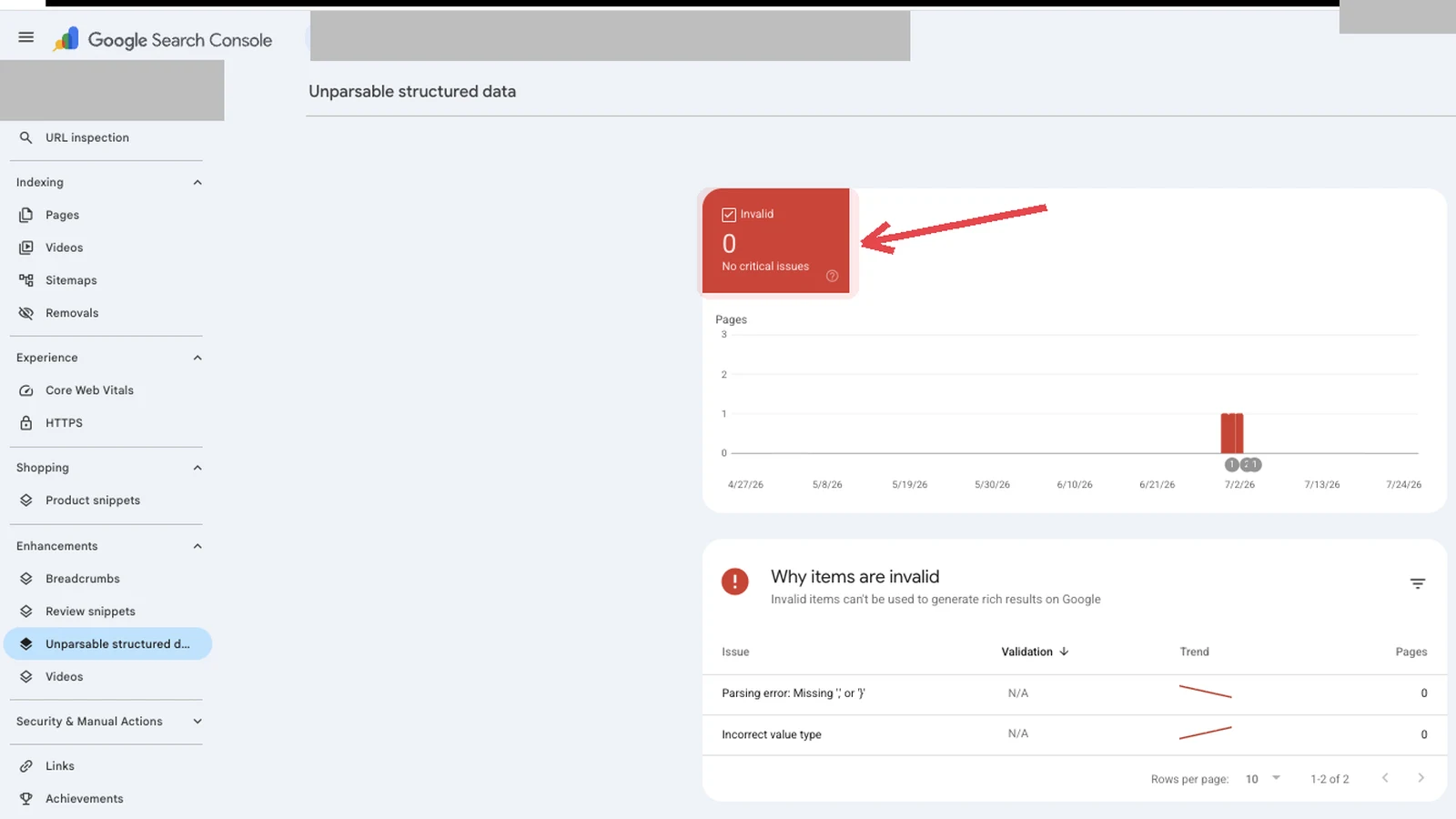
Yes, if you parse the stored markup. wpautop can inject tags into a multi-line schema block on save, and a parser throws the moment a tag lands inside the JSON, so a json.loads check flags exactly those posts.
How often should I run this check?
After every batch operation that touches many posts at once, and as a pre-publish gate on each new post. A one-off manual edit rarely needs it; a script that writes to hundreds of posts always does.
My Thoughts
The lesson that stuck from this wasn’t about schema at all. It was about trusting a green report that could only ever describe part of the system. My published posts were fine and the tool told me so, and the accuracy of that answer is what made it dangerous, because it let me believe the queue was fine too. Now I treat any check that reads public URLs as a check of my live pages only, never of my pipeline. When something can be wrong in a place a crawler can’t reach, the validation has to go where the crawler can’t: into the stored content, across every status, parsed rather than glanced at.